

Authors: Elsie Makachiya1, Poojita Karchalkar1, Onesimus Ekechi1, Magali Ruffier1, Jessica Barrett2 and Angela Wood2.
¹ Health Innovation East, Eastern England Secure Data Environment, UK
2 University of Cambridge, UK
Heart failure is a growing challenge for healthcare systems. In England, around 1 in 5 patients admitted with heart failure are readmitted within 30 days. That’s a big problem – and we’re working to change it.
At the Eastern England Secure Data Environment (EE-SDE), we’ve launched a project to turn real-world health data into research-ready insights using the OMOP Common Data Model (Observational Medical Outcomes Partnership)1. This means better tools, better decisions, and ultimately, better care.
Why OMOP Matters for Better Healthcare Data
Hospitals often store health information in different formats, which makes it hard for researchers to compare results or work together. Even a simple test like blood glucose can be recorded differently across the NHS. One hospital might write it as “blood sugar,” another as “glucose,” and labs may use different units. The OMOP Common Data Model makes sure all of these versions are stored in the same standard format so they’re easy to compare and study.
OMOP makes sure:
- Health information is stored in the same structure everywhere
- Diseases, medications, and tests use the same names and codes
- Researchers can use the same tools and methods to study data
- Hospitals can collaborate using common standards while maintaining strong data governance and privacy protections
In short, OMOP helps health data “speak the same language,” making research faster, more accurate, and more useful for improving patient care around the world. Figure 1 shows the OMOP process translating three hospitals’ data into a common global language, so it fits neatly into the OMOP standard.

Why This Matters

Heart failure patients often end up back in hospital within a month because small problems can quickly turn into big ones. Better data can help clinicians identify risks earlier and support more coordinated care:
- Every patient is different – Heart failure affects people in different ways. Good data helps doctors understand each person’s unique situation so they can give more personalised care.
- Problems show up in many places – A patient’s weight, symptoms, medications, home situation, and follow-up care all provide information about the likelihood of readmission. Better data gives a full picture instead of just pieces.
- Early warning signs matter – Heart failure often worsens gradually. Daily weights, symptom reports, or device readings can warn doctors early so they can adjust treatment before it becomes an emergency.
- Smooth handoffs after discharge are crucial – Patients often get readmitted because of confusion about medications or missed follow-ups. Better data helps hospitals, primary doctors, and caregivers stay on the same page.
- Resources can be focused on the people who need them most – Some patients are at much higher risk of returning to hospital. Good data helps identify them so they can get extra support, like home health or telehealth check-ins.
- Non-medical issues matter too – Things like trouble paying for prescriptions, not having transportation, or lacking a support system can lead to readmission. Better data helps uncover these issues so help can be offered.
Better data means better decisions. By standardising patient-level information from electronic health records, we’re enabling research that could lead to:
- More accurate risk prediction tools.
- Smarter clinical decision-making.
- Reduced hospital readmissions.
The Approach
We securely collected data from NHS trusts covering admissions, diagnoses, medications, and test results and mapped it to the OMOP Common Data Model, a global standard for healthcare data interoperability.
This process involved:
- Secure transfer of data into the EE-SDE
- Extract, Transform, Load workflows using Amazon Web Services 2 and custom Python/R scripts
- Mapping demographics, (e.g. age, gender, address) hospital admissions, and clinical events to OMOP tables like Person, Observation, and Visit Occurrence. Please note that that identifiable data is not mapped to OMOP
- Despite challenges like non-standard vocabularies and large datasets, we successfully converted heart failure data into the OMOP Common Data Model
We undertook the Extract Transform Load process in OMOP (see Figure 3) which involves taking healthcare data from different NHS systems, cleaning it up, and putting it into the OMOP format so everything is consistent
- Extract means taking the data out of the hospital’s computer systems
- Transform refers to the process of data cleaning, organising, and making sure that everything uses the same names and formats so it fits the OMOP standard
- Load is when researchers move the cleaned and standardised data into the OMOP database, where it can be used easily

Extract Transform Load is like taking messy, health information which is labelled differently, tidying it, and organising it so everyone can understand and analyse it in the same way.
How OMOP Helps Health Data “Speak the Same Language”
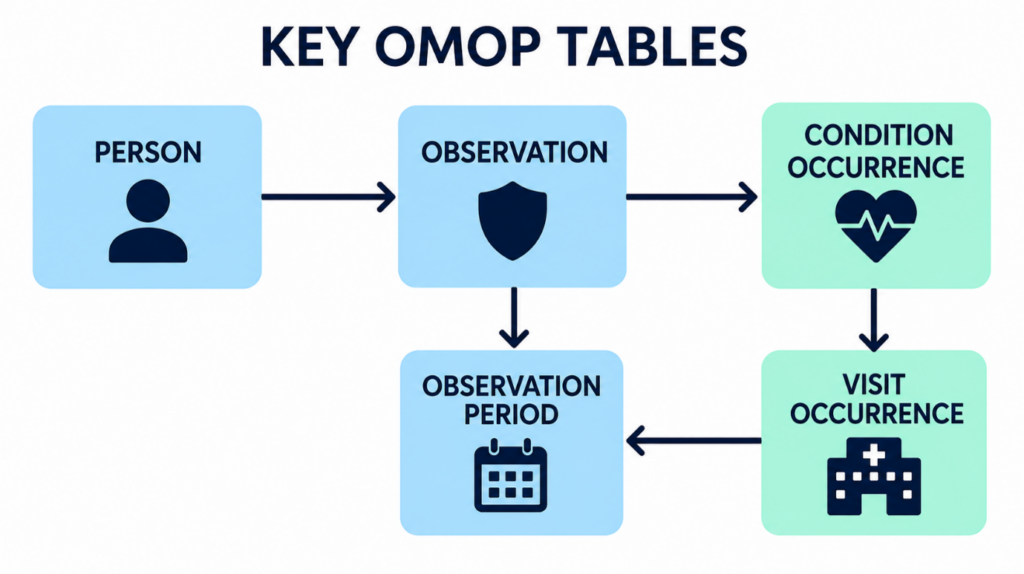
Health information is stored differently in every hospital, which makes it hard for researchers to compare or combine data. OMOP fixes this by giving everyone a standard way to organise and label health records.
Here’s what OMOP does in plain terms:
- Puts data into the same folders – It organises information (like medications, diagnoses, and visits) into the same types of tables everywhere
- Uses the same labels – It uses worldwide standard codes so that a disease or medication is named the same way no matter where it comes from
- Makes teamwork easy – Once data is in OMOP format, researchers around the world can use the same tools and methods, so their results match and can be compared
- Works with big systems – OMOP can handle huge amounts of data and allows groups to work together without sharing private patient information
OMOP turns messy, inconsistent health records into one clear, shared language. This helps researchers learn faster, improves healthcare tools, and lets hospitals and countries benefit from each other’s knowledge.
The Impact
Within the Eastern England Secure Data Environment, researchers can now:
- Access high-quality, standardised de-identified health data in a secure environment
- Researchers can now run analyses securely
- Use R and Python notebooks for analysis
- Discover cohorts across multiple data providers using a federated tool, enabling collaborative studies that were previously impossible
“By converting data from multiple NHS organisations into a shared OMOP format within the Eastern England Secure Data Environment, researchers can now analyse datasets across organisations using consistent methods and tools. This creates opportunities for larger-scale studies, reproducible analytics, and collaborative research that would previously have required substantial manual harmonisation” – Professor Angela Wood, May 2026.
Looking Ahead
This project is more than a technical achievement – it’s a foundation for future research that could transform heart failure care. By unlocking real-world data, we’re paving the way for innovations that improve lives.
Learn more about the Eastern England Secure Data Environment and ongoing projects here.
References
- Observational Health Data Sciences and Informatics (OHDSI). Standardized Data: The OMOP Common Data Model. 2025. Available from: Data Standardization – OHDSI. Accessed 2025 Dec 4.
- Amazon Web Services (AWS). What is ETL (Extract Transform Load)? 2025. Available from: What is ETL? – Extract Transform Load Explained – AWS. Accessed 2025 Dec 4.